Where Should You Start Improving an Artisan Business?

Most artisan business owners can identify several things they would like to improve. The harder question is deciding which improvement will actually make the greatest difference. A useful place to begin is not with a new tool or a major overhaul, but by understanding how the business works and following one important workflow closely enough to see where change matters most.
A shop owner can usually name several things they would like to improve.
Customer inquiries could be handled more consistently. Estimates take longer than they should. Production priorities occasionally become unclear. Someone has to track down a material order. Customers sometimes call for an update because no one remembered to send one. There may also be software that could be used better, procedures that should be documented, or repetitive work that seems as though it ought to be automated.
The difficulty is rarely finding something that could be improved.
The difficulty is deciding where to begin.
In an established artisan business, the parts of the business are connected. A change that appears to belong to production may actually begin with information collected during the customer consultation. A scheduling problem may trace back to estimating. A customer communication issue may really be a visibility problem because no one can easily see the current status of the job.
That makes isolated fixes tempting, but sometimes misleading.
A better starting point is to understand how the business works before deciding what needs to change.
First, look across the whole business
This does not require months of analysis.
The purpose is simply to follow the movement of work from the beginning of the customer relationship to the end.
For a custom framing shop, that might mean looking at what happens from the first inquiry through consultation, design, estimating, ordering, production, fitting, quality review, pickup, and follow-up.
As you follow that path, certain patterns begin to appear.
Perhaps customer requirements are recorded in several places. Maybe production employees regularly return to the salesperson for clarification. Perhaps the owner is the only person who knows which jobs deserve immediate attention. Maybe customer updates depend largely on someone remembering to send them.
At the same time, you will also see the things that already work well: experienced employees making sound decisions, useful software already in place, effective production routines, good customer relationships, or informal practices that have developed over years.
That matters. Improvement should build upon those strengths rather than replacing them simply because a different system is available.
The objective at this stage is visibility.
You are trying to understand enough of the business to distinguish an occasional annoyance from an operating issue that repeatedly consumes time, creates uncertainty, or affects the customer experience.
Then make one important workflow visible
Once the broader picture becomes clearer, the next step is not to create a giant improvement plan.
Choose one workflow that matters.
Imagine a furniture maker where approved commissions move from the designer to purchasing and then into production. The process works, but information about dimensions, finish choices, hardware, material availability, and promised completion dates is scattered among drawings, emails, conversations, and the owner's memory.
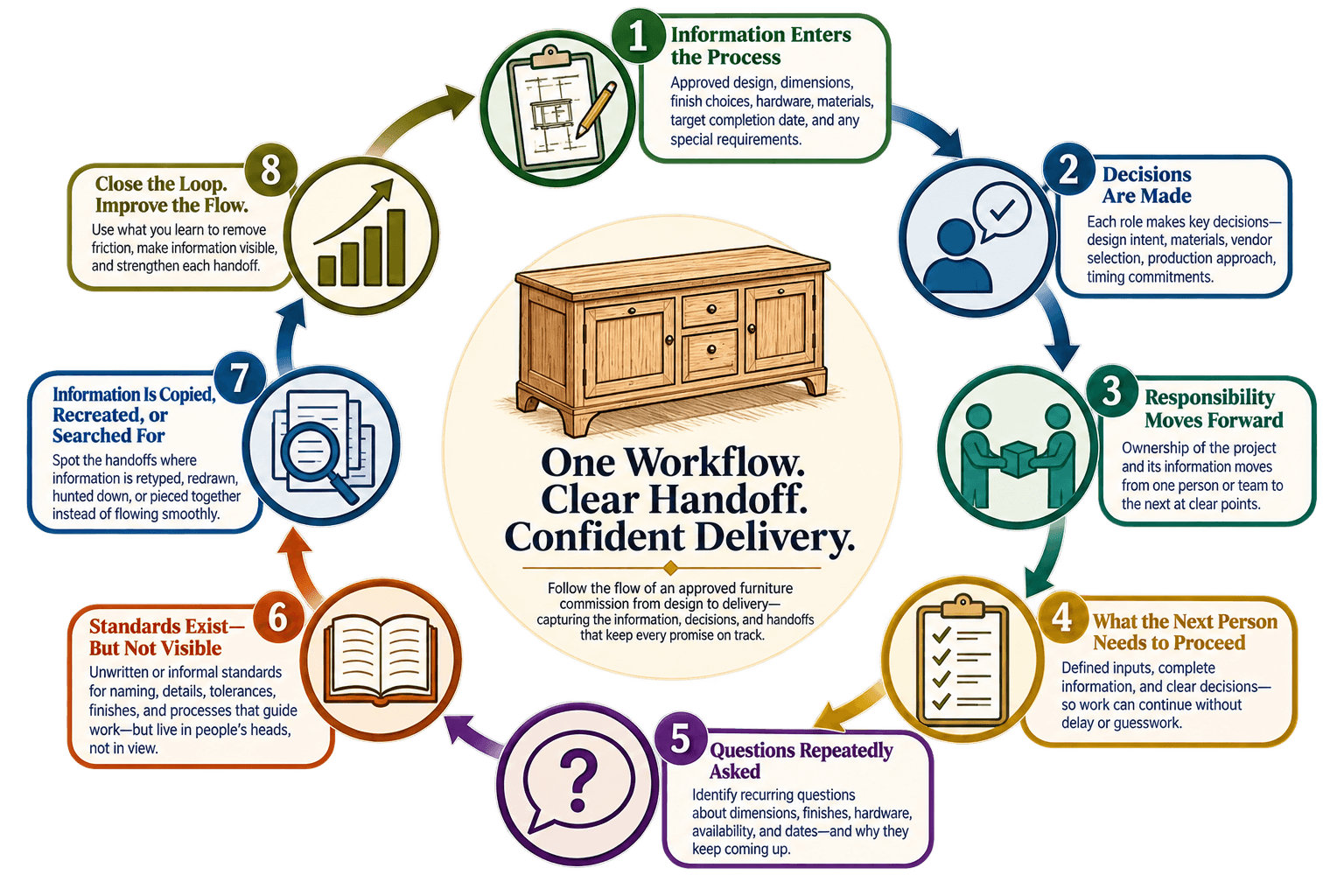
Strengthen the part that matters most
Only then does it make sense to design an improvement.
Sometimes the answer will be surprisingly simple.
The shop may need a better intake structure so essential information enters the job correctly at the beginning. A handoff may need a clear definition of what must be complete before the work moves forward. A quality check may need to occur at a specific point rather than whenever someone remembers it. The team may need one shared view of job status rather than several separate lists.
In other situations, a checklist, communication template, simple dashboard, automation, or AI-assisted process may be useful.
But the tool comes after the problem is understood.
That distinction is increasingly important. There are now countless technologies capable of generating documents, organizing information, sending messages, creating reminders, and automating administrative work. Any of them can be impressive in isolation.
The useful question is whether one of them strengthens the way this particular business needs to operate.
Improvement becomes smaller and more practical
There is an appealing idea that improving a business requires a comprehensive transformation.
For many artisan businesses, the opposite approach may be more valuable.
Understand enough of the whole business to see where the meaningful opportunities are. Choose one important workflow. Make it visible. Improve the part that creates the greatest leverage. Then observe what changes.
Perhaps fewer questions reach the owner.
Perhaps production begins with better information.
Perhaps customers receive updates more consistently.
Perhaps employees can make decisions without searching for answers.
Perhaps the business gains a clearer picture of what is happening across the shop.
None of those changes requires abandoning the methods and knowledge that allowed the business to become successful in the first place. They come from examining those methods with the same care an artisan would bring to improving the work itself.
Over time, one well-chosen improvement can also reveal the next one.
That is how a stronger operating system can emerge—not from trying to redesign the entire business at once, but from understanding what is already there and strengthening it deliberately, one meaningful piece at a time.